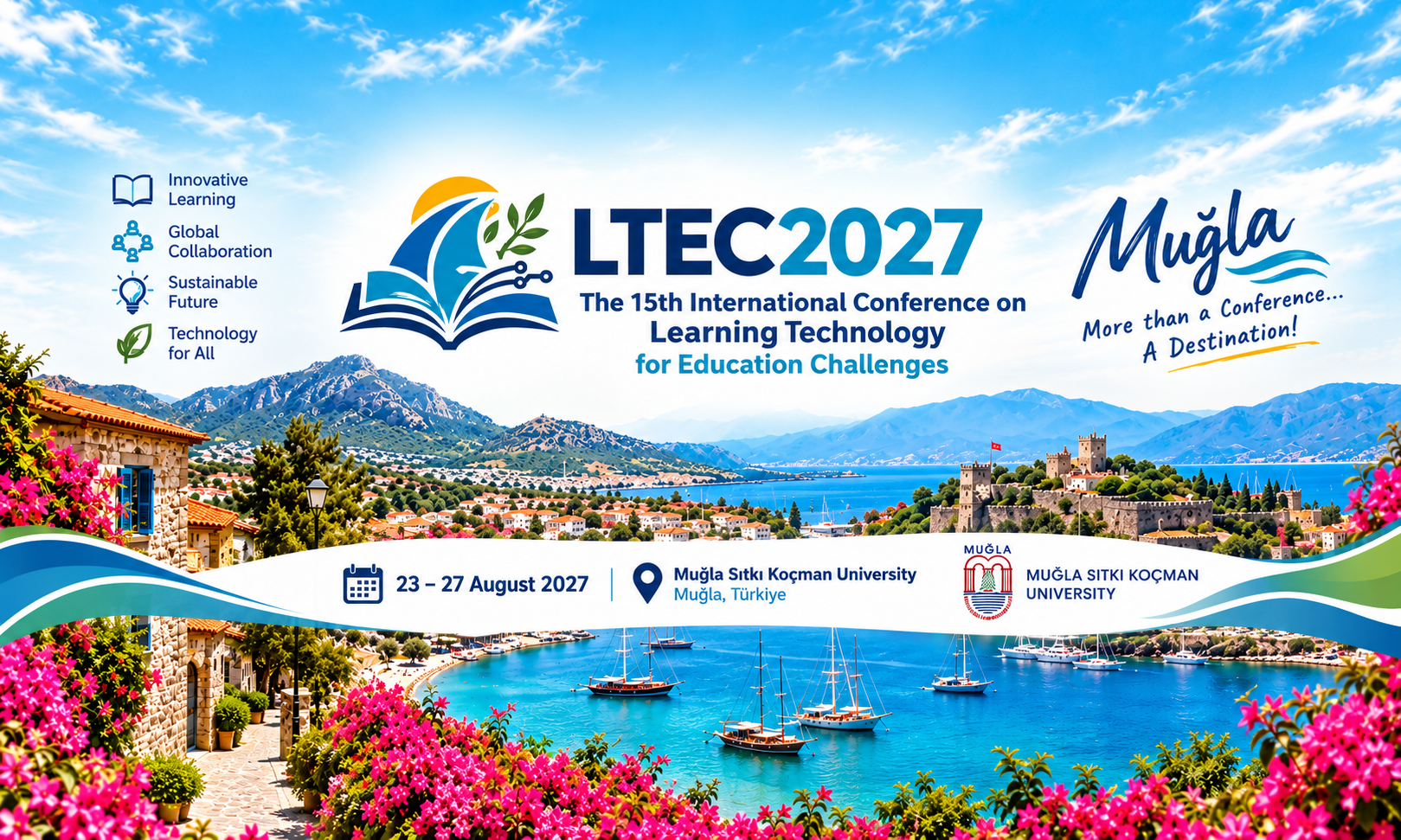
Education has entered a new phase of digital transformation. Generative Artificial Intelligence (GenAI) has rapidly become embedded in teaching, learning, assessment and educational administration. The emerging challenge is no longer simply whether artificial intelligence should be used in education, but how learning technologies can demonstrably enhance human learning, thinking, creativity, agency, well-being and inclusion.
LTEC 2026 explored Generative AI in Education and Learning through the emerging Education 5.0 paradigm, emphasising personalisation, inclusion, human–AI synergy and responsible integration of AI into pedagogy and curriculum.
LTEC 2027 advances this discussion beyond the initial adoption of Generative AI toward a more fundamental question:
How can intelligent and emerging learning technologies be designed, implemented and evaluated so that they strengthen rather than replace human learning?
This question is becoming increasingly important. Emerging evidence indicates that GenAI can improve students’ immediate task performance without necessarily improving learning. Excessive cognitive offloading may weaken independent thinking, metacognition and long-term skill development, whereas pedagogically designed AI can strengthen learning, augmentation, tutoring and collaboration.
Learning technologies are rapidly evolving beyond conventional chatbots. Agentic AI, multimodal AI, intelligent tutors, adaptive systems, learning analytics, immersive technologies and AI-supported educational agents are beginning to create new possibilities for personalised and lifelong learning. Agentic systems, in particular, raise new questions about what roles should remain distinctly human when AI systems can increasingly plan, remember, personalise and undertake educational activities autonomously.
LTEC 2027 therefore invites researchers, educators, learning technologists, practitioners, policymakers and industry partners to contribute theoretical, empirical, technological and practice-based research addressing the future of human-centred, intelligent and evidence-based learning technologies.
Key Themes and Topics
- Human-Centred AI and Human–AI Collaboration in Learning
- Agentic AI and Intelligent Educational Agents
- Learning Sciences, Cognition and Neuroscience-Informed Technology
- Rethinking Assessment in the Age of AI
- AI Literacy, Critical Thinking and Future Capabilities
- Personalised and Adaptive Learning
- Teachers, Teaching and Professional Development
- Ethics, Trust, Governance and Responsible AI in Education
- Inclusion, Accessibility and the AI Divide
- Emerging Learning Technologies
- Innovative Pedagogies and Technology-Enhanced Learning
- Evidence-Based Learning Technology Research
Key Questions for LTEC 2027
The conference particularly encourages research addressing questions such as:
Does using AI improve learning—or merely improve students’ immediate performance?
How can learning technologies augment rather than replace cognitive effort?
What should remain distinctly human in increasingly agentic educational environments?
How should assessment change when AI can generate high-quality student work?
How can educational AI promote critical thinking, creativity, metacognition and deep learning?
How can teachers maintain professional agency while collaborating with increasingly autonomous AI?
How can learning technology be grounded more strongly in cognitive science and educational neuroscience?
How should educational institutions govern increasingly powerful AI systems?
How can personalised AI support inclusion without increasing educational inequality?
What constitutes convincing evidence that a learning technology actually improves learning?
Types of Contributions
LTEC 2027 welcomes:
- Full research papers
- Theoretical and conceptual papers
- Empirical studies
- Systematic and critical reviews
- Design and development research
- Educational technology evaluations
- Case studies
- Work-in-progress research
- Practitioner studies
- Doctoral research
- Industry–academic research
- Policy and governance studies
Research should clearly identify its educational problem, theoretical foundation, methodology, evidence and contribution to learning technology.
- Tutorials
In addition to the conference, there will be pre-conference tutorials relating to the state of the art in the topics of the conference. Invitation for submission to the tutorial can be found in Call for Tutorials.
Deadline for tutorial submission: 20thJunary, 2027
Instructions for Authors
Papers reporting original and unpublished research results pertaining to the above topics are solicited (Proceedings will be published by Springer CCIS series indexed in SCOPUS). Full paper and all submissions deadlines are 20th January 2027. These papers will undergo an academic review process. Full paper manuscripts must be in English with a maximum length of 12 pages (using the Springer template). All papers are blind reviewed.
IMPORTANT: Please do not include the author(s) information in the FIRST submission of the paper, for double-blind review to be carried out.
More information in Springer publication; please see: Communications in Computer and Information Science (CCIS).
Review Process:
LTEC 2027 welcomes the submission of papers with reference to the topics listed in the call for papers. All submitted papers will undergo a double-blind peer review by at least three experts in the field, based on relevance, originality, significance, quality and clarity.
Submitting Papers:
All papers must be formatted according to the Springer template, with a maximum length of 12 pages, including figures and references. All proposed papers must be submitted in electronic form (WORD format) using the Paper Submission Page
Publication:
Accepted papers will be included in LTEC 2027 Proceedings. At least one of the authors will be required to register and attend the symposium to present the paper in order to include the paper in the conference proceedings. All accepted papers will be published by Springer Verlag (LECTURE NOTES in Communications in Computer and Information Science (CCIS) indexed in SCOPUS.
Important Deadlines
Deadline for paper submission: 20thJunary, 2027
Author Notification: 20th March 2027
Deadline for camera-ready paper: 4thJune, 2027